
Stopping Condensation in Insulated Steel Buildings | Dew Point, Vapor Retarders and Airflow in Climate Zone 4A
Topeka Expert Pole Barn Builders insulates shops, barndominiums and barns that face more than a hundred freezing nights a year, and we plan for condensation on every one. This guide explains why bare steel drips, which assemblies hold up in climate zone 4A and how we ventilate buildings that hold animals or hay.
Most condensation problems we are called to look at come from a missing or misplaced vapor retarder, or from a building closed up with no way for moist air to leave. We design the wall assembly and the airflow together, before the steel is ordered.
- 25+ years in the trade
- Licensed & insured
- Family-owned
- Free on-site estimates
- Hablamos español
- 4AIECC climate zone, Shawnee and nearby counties
- 4,860Heating degree days a year in Topeka (NOAA)
- 114Days a year at or below 32°F in Topeka
- 4°FWinter design temperature in Topeka's code
Why Bare Steel Sweats on a Cold Night
We explain condensation by the dew point, because every fix we use works on it. Warm air holds more water vapor than cold air. When air touches a surface colder than its dew point, the air at that surface cools until it cannot hold its vapor, and water forms. Steel is thin and conducts heat fast, so a roof panel tracks the outdoor temperature, and on a clear night it radiates heat to the sky and drops below the air temperature.
We see that mechanism at work most of the winter. NOAA's 1991 to 2020 normals for Topeka's Billard airport show about 114 days a year with a low at or below 32°F and 4,860 heating degree days, and on each of those nights an uninsulated roof is colder than the air in a heated shop or a full barn.
We also look at where the water comes from. Unvented propane and kerosene heaters put vapor into the room as they burn, fresh concrete releases water for weeks, livestock breathe and urinate, and snow melts off vehicles. On cold steel that vapor drips on equipment, rusts fasteners and soaks fiberglass.
What Climate Zone 4A Asks of Walls and Roofs
We design to climate zone 4A, Mixed-Humid, which PNNL assigns to Shawnee, Douglas, Jefferson, Jackson, Pottawatomie, Osage and Wabaunsee counties. In winter, vapor drives outward from a warm interior toward cold steel; in a humid summer the drive can reverse in an air-conditioned building. An assembly that traps moisture between two vapor-tight layers fails in one season or the other, so we build walls that can dry in at least one direction.
Energy code depends on location. Topeka applies the 2009 IECC to residential buildings (TMC 14.80.010), and unincorporated Shawnee County adopts that chapter by reference; Lawrence and Douglas County use the 2018 IECC. For a barndominium we check the insulation and air-sealing rules of whichever edition the permit office enforces before we price the shell. A barn or shop that is not a dwelling usually sits outside that code but faces the same dew point.
Where the Vapor Retarder Goes and Why
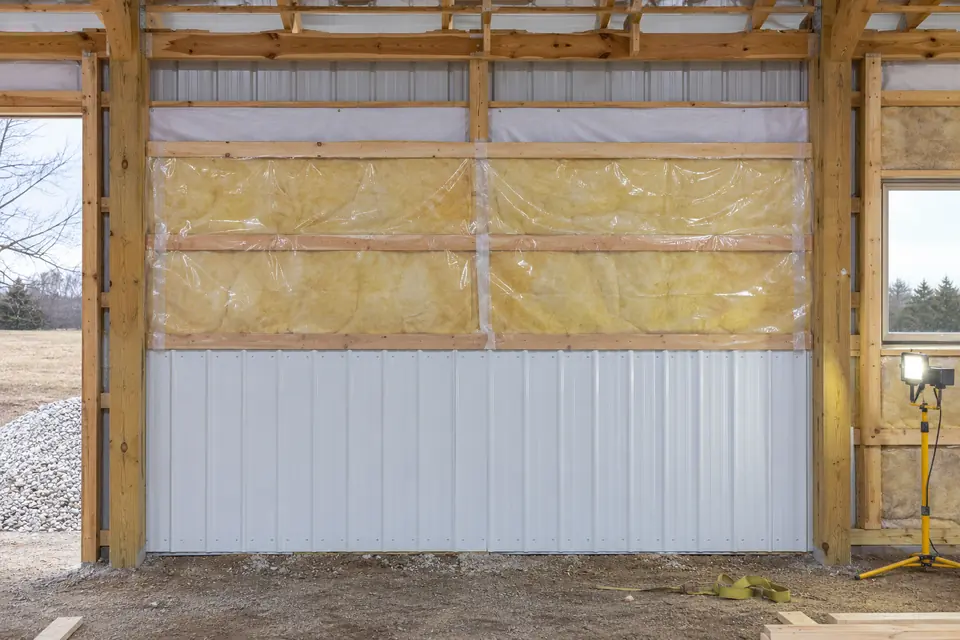
We put the vapor retarder on the warm-in-winter side of the insulation, which in a heated building is the interior face. It stops room air from carrying vapor into the insulation, where it would reach the cold steel and condense. Behind the steel we use housewrap, which sheds wind and water but lets vapor pass, so moisture that does get in can dry outward.
Air leaks carry far more moisture than vapor diffusing through materials, so the retarder only works when it is continuous. We tape the laps, seal around boxes and window frames and carry it up to the ceiling liner. We never sandwich fiberglass between two vapor-tight layers because moisture in that cavity cannot leave.
Closed-Cell Spray Foam or Fiberglass with a Liner
We use closed-cell spray foam where the building will be heated or finished. Sprayed directly on the underside of the steel, it bonds to the panel, fills the ribs and leaves no air gap for condensation. At full thickness it is its own air barrier and vapor retarder. It costs more, and the panels and fasteners behind it are hard to inspect or replace later.
Fiberglass works when it is detailed right. In the roof we roll faced blanket over the purlins with the facing toward the interior and the seams taped; in walls, thick batts fill the deep cavity between posts with a vapor retarder and a liner panel or drywall inside. For an unheated machine shed that only needs to stop drips, a roof panel with a factory anti-condensation fleece is often enough, and we say so when full insulation is not worth the money.
| Approach | Where we use it | What we watch for |
|---|---|---|
| Closed-cell foam on the steel | Heated shops, barndominiums | Full thickness at laps and ribs |
| Faced fiberglass blanket over purlins | Heated or part-heated shops and garages | Taped seams, facing on the warm side |
| Batts in the post cavity with liner | Shop and barndominium walls | Continuous, sealed vapor retarder |
| Anti-condensation fleece on roof steel | Unheated sheds and hay storage | Stops drips only; it is not insulation |
We never leave unfaced fiberglass against bare steel in a heated building. Moist room air passes straight through it, condenses on the panel and the wet batt sags out of the purlins.
Ventilation Carries Off What Insulation Cannot
We ventilate every building we insulate, because insulation slows heat loss and does nothing about water already in the air. Intake at the eaves and exhaust at the ridge let warm, moist air rise and leave while drier outdoor air replaces it. In a heated shop we add an exhaust fan and steer owners to vented heaters, which send combustion moisture outside. Mini-split heat pumps dehumidify as they cool, and we plan airflow with the heating trades so the building breathes without dumping its heat.
Slab Vapor Barriers and Moisture from Below
We lay a vapor barrier under every interior slab we pour in an enclosed building. Ground moisture moves up through concrete all year, and without a barrier a shop floor feeds vapor into the air and stays damp under stored goods. We lay the sheet over a compacted base, lap and tape the seams and seal it around posts and pipes.
New concrete also gives off a lot of water as it cures, so we keep the building ventilated after the pour and hold off closing the ceiling liner until the slab has dried back. Outside, we grade away from the walls and gutter the eaves so roof water does not soak the ground under the slab.
Livestock Barns, Hay Storage and Ridge Vents
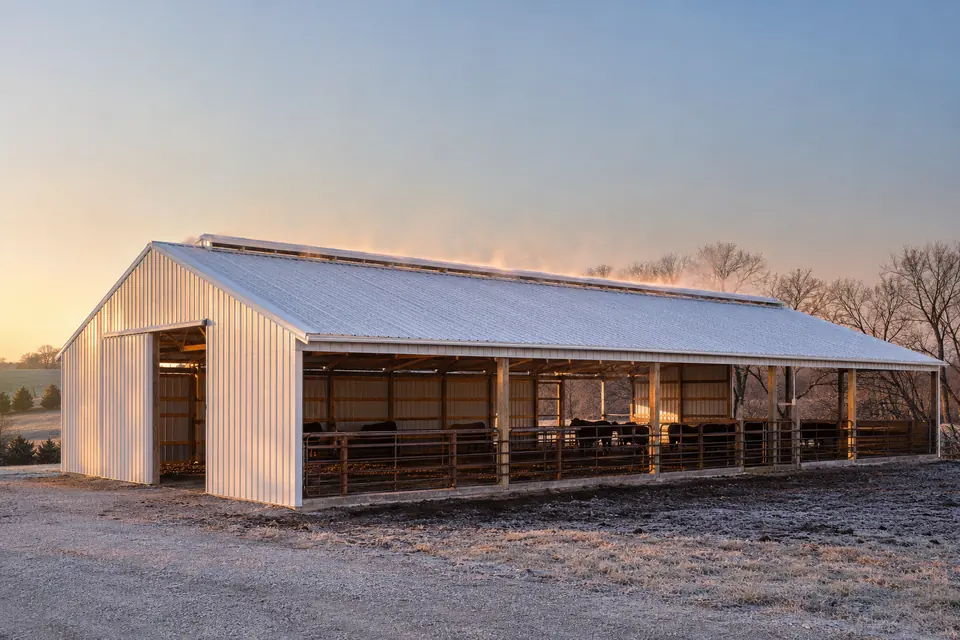
We usually leave livestock barns uninsulated and move air through them instead. Cattle, sheep and horses make moisture and ammonia around the clock, and ammonia corrodes steel and fasteners. Open or vented eaves bring fresh air in low, and a ridge vent lets warm, damp, ammonia-laden air out at the peak. Mono-slope cattle sheds open on the low side ventilate themselves.
Where a barn needs a heated room, such as a foaling stall or tack room, we build that room as its own envelope with a vapor retarder and a fan. Hay and grain storage get a ridge vent and anti-condensation roof panels so drips do not mold the top bales. Our livestock barn builds start with the airflow plan.
Barndominium Wall Assemblies That Dry Out
We build barndominium walls as house walls with steel siding. From outside in: steel, housewrap, girts, insulation filling the deep post cavity, a continuous vapor retarder on the warm side, and drywall. Closed-cell foam in the cavity is the alternative and handles air sealing and vapor control in one layer. Either way the steel stays a rain screen and never serves as the vapor barrier.
A tight house needs controlled fresh air, so we coordinate mechanical ventilation and a mini-split or ducted system with the HVAC contractor. In Topeka a permitted house gets an insulation inspection after framing approval, and we book it before drywall arrives. Our barndominium builds use this assembly, and the footing guide covers the foundation under it.
Condensation and Insulation Questions We Get
Does a building permit in Topeka bring an insulation inspection?
On a building permitted under Topeka's residential code, yes. The inspection sequence in TMC 14.55.170 includes an insulation inspection after the framing inspection is approved, with the final before anyone uses the building. We schedule each one, keep the vapor retarder and liner off until the inspector has seen the insulation, and hand you the inspection record at the end.
Why does my uninsulated barn roof drip on winter mornings?
Because the underside of the steel cooled below the dew point of the air inside overnight. Clear skies let the roof radiate heat and drop below air temperature, and moisture from animals, damp ground or a heater condenses on it, then drips as the sun warms the panel. We fix it with ridge and eave ventilation, a drier floor or an anti-condensation roof liner.
Can I insulate an existing pole barn without taking the steel off?
Yes, in most cases. Closed-cell spray foam can go directly on the existing roof and wall steel from inside, which also stops the drips, and faced fiberglass can fill the wall cavities behind a new liner panel. We check the steel and fasteners for rust first, because foam hides them, and we replace damaged panels before insulating.
Is spray foam worth it in an unheated machine shed?
Usually not. An unheated shed only needs to stop drips on equipment, and a roof panel with an anti-condensation fleece plus ridge and eave ventilation does that for far less. We recommend closed-cell foam where you will heat the building, store tools or vehicles that rust, or finish the interior, and we tell you plainly when the cheaper approach is enough.
Will a propane heater make my shop sweat?
An unvented one can. Burning propane produces water vapor, and an unvented heater releases all of it into the shop, where it condenses on cold steel, tools and vehicles. A vented heater sends the combustion products outside. We recommend vented units in insulated buildings and add an exhaust fan where unvented heat is already in use.
Should a horse barn be insulated?
Usually only in specific rooms. A horse barn stays healthier with plenty of air movement, and insulating the whole shell tends to trap moisture and ammonia. We ventilate the barn through the eaves and a ridge vent and use anti-condensation roof panels over the stalls. A tack room, office or foaling stall can be insulated and heated as its own space.
Can steel siding act as the vapor barrier in a barndominium?
No, and we never design it that way. The steel is cold in winter, so vapor that reaches it condenses inside the wall cavity, where it cannot dry. We put the vapor retarder on the warm, interior side of the insulation and use housewrap behind the steel, which sheds water but lets the wall dry outward.
What drives the cost of insulating a steel building?
The insulation type, the area covered and whether the building is heated drive most of it. Closed-cell foam costs more than fiberglass for the same area, a liner panel or drywall adds material and labor, and ventilation, vented heat and a slab vapor barrier add smaller items. We list each choice separately on a free written estimate.
Sources we work from
- NOAA NCEI 1991-2020 normals, Topeka Billard airport (USW00013996) https://www.ncei.noaa.gov/access/services/data/v1?dataset=normals-annualseasonal-1991-2020&stations=USW00013996&format=json
- PNNL, Guide to Determining Climate Zone by County (2022) https://www.osti.gov/servlets/purl/1893981/
- Topeka Municipal Code 14.80.010, 2009 IECC residential https://topeka.municipal.codes/TMC/14.80.010
- City of Topeka Ordinance 20467, inspections and Table R301.2(1) https://files.topeka.gov/community/ordinances/2023/Ordinance20467.pdf
- Shawnee County Building Code adoption https://www.snco.gov/ludev/building_code.php
- City of Lawrence adopted codes https://lawrenceks.gov/pds/adopted_codes
Insulating a Steel Building Near Topeka?
Tell us how you will heat and use the building. We match the insulation, vapor retarder and ventilation to it and send a free written estimate.