
The Kansas Agricultural Exemption for Farm Buildings | What Qualifies, County by County, Around Topeka
Topeka Expert Pole Barn Builders puts up hay barns, machine sheds and livestock buildings across six counties, and we deal with the agricultural exemption on nearly every one. This guide sets out what the Kansas statutes say, how each county around Topeka applies them and where the exemption stops.
We get the exemption determination in writing before we order materials, and we still call 811, check the flood map and line up trade permits where they apply. The exemption changes the paperwork, and our engineering and construction stay the same.
- 25+ years in the trade
- Licensed & insured
- Family-owned
- Free on-site estimates
- Hablamos español
- 19-2921K.S.A. section exempting farm buildings from county zoning
- 2016-10AG opinion barring county codes on farm buildings
- 3 acresMinimum ag use for a Douglas County exemption
- 1 ftAbove base flood elevation, farm buildings included
What K.S.A. 19-2921 and 12-758 Say About Farm Buildings
We read the statute before the county form, because the form only applies it. K.S.A. 19-2921 (county zoning) and K.S.A. 12-758(b) (the current planning and zoning act) say, in substance, that except for floodplain regulations in designated floodplain areas, zoning regulations do not apply to the use of land for agricultural purposes, "nor for the erection or maintenance of buildings thereon for such purposes so long as such land and buildings erected thereon are used for agricultural purposes and not otherwise."
We read three tests in that sentence. The land has to be in agricultural use, the building has to be put up for that use, and the use has to continue, which is the work the words "and not otherwise" do. A building that passes all three on the day it is finished can lose the exemption later.
Kansas AG Opinion 2016-10 carried the reasoning into construction codes: a county may not require a building used solely for agriculture to comply with county construction codes. It may require a prior determination that the building is exempt, but once that is made it may not require plan approval or a building permit. With no statewide building code, that is often our whole approval.
Why the Exemption Stops at the City Limits
We tell customers early that there is no statutory agricultural exemption inside city limits. Topeka adopted IBC Appendix C for Group U agricultural buildings (Ord. 20648), so a barn in Topeka goes through permit and inspection under that appendix, and Lawrence has no general farm-building exemption. In the three miles a city may zone beyond its boundary, K.S.A. 12-715b bars it from regulating land over three acres under one ownership used only for agriculture. We check the city limit line on the parcel map before we call anything exempt.
Floodplain Rules Apply to Exempt Barns Too
We check the flood map on every farm parcel, because both statutes carve floodplain regulations out of the exemption. Kansas floodplain rules meet the federal NFIP minimums and are approved by the chief engineer at the Kansas Department of Agriculture (K.S.A. 12-766). Under K.A.R. 5-44-4, development in a mapped floodplain needs a floodplain development permit from the local floodplain administrator, ag buildings included.
A nonresidential building there has to be elevated or dry floodproofed to 1 foot above the base flood elevation, with floodproofing certified by an engineer or architect. On river-bottom parcels we pull the flood map first and plan the elevation, fill and permit before the layout is final.
How Each County Around Topeka Handles Farm Buildings
We work in six counties that apply the same statutes in different ways. We confirm the current form with the office for each parcel, because procedures change faster than statutes.
| County | What the office asks for | What stays regulated |
|---|---|---|
| Shawnee | Affidavit of Agricultural Exemption with a filing fee; proof the principal use of land and building is agricultural | Dwellings and garages, which never qualify; floodplain permits |
| Douglas | Exemption before construction, no fee; Schedule F, 3 acres in ag use, site plan, floor plan, notarized affidavit | Electrical, plumbing and HVAC permits; floodplain rules |
| Jefferson | Zoning certificate before a new building is used, no fee for ag use | Floodplain rules; setbacks on major roads |
| Osage | New ag buildings exempt from zoning | Floodplain rules; setbacks on major roads |
| Pottawatomie | Building permit to check floodplain and setbacks, no fee on 40 acres or more | The permit itself |
| Jackson | Zoning Compliance Certificate | Details confirmed with the county |
In Shawnee County we file the affidavit with you, and the county's own rule says dwellings, garages and similar accessory buildings are never agricultural, so a house, barndominium or garage does not qualify. In Douglas County we assemble the packet: the prior-year IRS Schedule F (or a business plan or ag loan for a new producer), at least 3 acres in ag use, an entrance permit, a site plan showing the floodplain, a floor plan and a notarized affidavit. Trade work there still gets permits and inspections.
Buildings That Qualify and Buildings That Usually Do Not
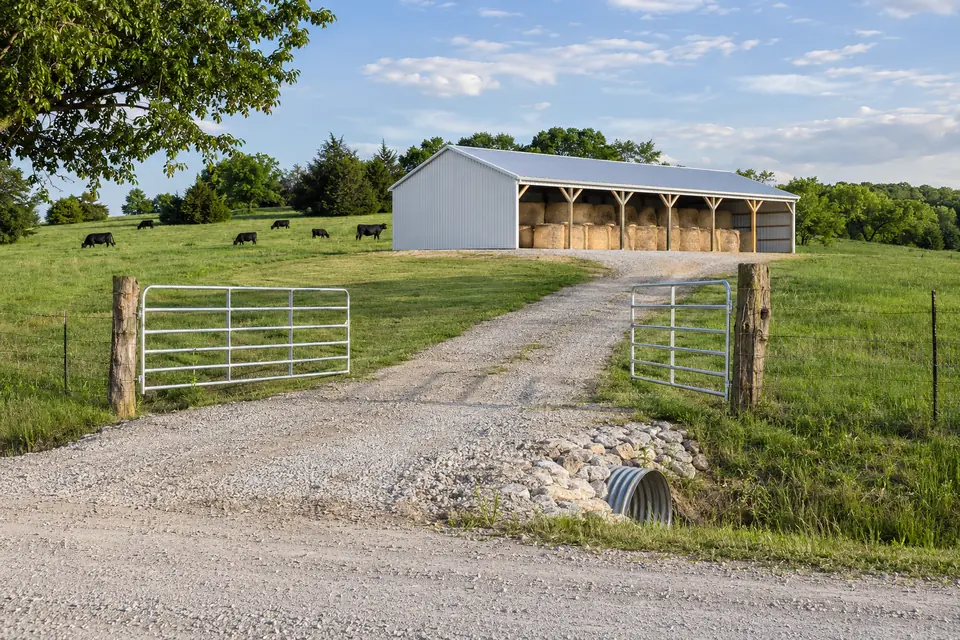
We start from the state's own definition. K.S.A. 74-7003(a) defines an agricultural building as one that houses hay, grain, poultry, livestock or horticultural products or stores farm implements, and excludes places of human habitation, workplaces that process or package farm products, and buildings for public use. The same law, K.S.A. 74-7031(b) and 74-7033(b), exempts farm buildings from licensed design. We still order engineered truss drawings for every building, because the exemption leaves the wind and snow unchanged.
- Usually qualifies: hay and grain barns, machine sheds, livestock barns, horse barns on an operating farm
- Usually does not: hobby or vehicle shops, RV storage, detached garages, barndominiums or anything with living quarters
- Depends on the facts: a barn with a farm office, a farm stand, a horse facility that boards or teaches the public
- Never covered: floodplain permits
Farm Dwellings and the Blauvelt Decision
We get asked whether a house on a working farm can be exempt. In Blauvelt v. Board of Leavenworth County Commissioners, 227 Kan. 110 (1980), the Kansas Supreme Court held on the facts of that case that a farm dwelling could fall within agricultural purposes and escape county zoning. It addressed zoning, it turned on one farm's facts, and county practice here points the other way.
Shawnee County says dwellings are never agricultural buildings, and Douglas County excludes places of human habitation. We do not build a home or a barndominium on the strength of Blauvelt. We pull a residential permit, and an owner who wants to press the argument should take it up with the county and an attorney before we schedule the build.
When a Farm Building Changes Use
We plan for the day the use changes, because the statute's test runs as long as the building stands. A machine shed that becomes a rental shop, a hay barn turned into a wedding venue or a horse barn that gains an apartment is no longer used for agriculture and not otherwise. Douglas County spells it out: a change of use requires a building permit and professional qualification of the structure.
A building designed to Risk Category I farm loads may also fall short once people work in it, so when an owner expects a change we design to Category II now, which costs far less than a retrofit. Our wind and design load guide explains the categories.
Our Paperwork Checklist for an Exempt Farm Building
We run the same list on every farm job so the building is not held up halfway.
- We confirm the parcel is outside city limits and which county office applies
- We pull the flood map and apply for a floodplain development permit if any of the site is mapped
- We gather the farm records the county asks for, such as a Schedule F
- We draw the site plan with road setbacks and the floor plan
- We get the exemption or zoning certificate in writing before trusses are ordered
- We call 811 and schedule licensed trades for any permitted electrical, plumbing or HVAC work
Agricultural Exemption Questions We Answer Most
Does an exempt hay barn in Shawnee County still need permit paperwork?
Yes. Unincorporated Shawnee County asks for an Affidavit of Agricultural Exemption with a filing fee, and its packet also lists a septic site evaluation, an Affidavit of Code Compliance and a stormwater affidavit. A floodplain development permit is still needed if the site is mapped. We prepare the site plan and file the affidavit with you before construction, so the exemption is on record before we dig.
Can I get the Douglas County exemption on a two-acre parcel?
Not under the county's current criteria. Douglas County requires at least 3 acres in agricultural use, plus a prior-year Schedule F or, for a new producer, a business plan or agricultural loan. On a smaller parcel we plan the building as a permitted accessory structure with a county building permit and inspections. We check the acreage on the parcel record before we draw anything.
Does an ag-exempt barn need an electrical permit?
In Douglas County, yes. The exemption covers the building, but electrical, plumbing and HVAC work still need permits and inspections. In other counties we confirm the rule with the office for your parcel. We coordinate a licensed electrician for any barn with power, lights or water heaters, and we leave the wiring chases open until the trade inspection is done.
Can a barndominium on a working farm qualify as an agricultural building?
Around Topeka we treat the answer as no. Shawnee County's rules say dwellings are never agricultural buildings, and Douglas County excludes places of human habitation. The Kansas Supreme Court found a farm dwelling exempt from zoning in Blauvelt on that case's facts, but we do not rely on it. We pull a residential permit for every home we build.
Do I need the exemption approved before construction begins?
In Douglas County, yes, it must be granted before construction. AG Opinion 2016-10 says any county may require a prior exemption determination, and Shawnee County works through a filed affidavit. We treat written approval as a condition of ordering materials in every county, because building first and asking later risks penalty fees, delays and a building that may have to come down.
Does Pottawatomie County charge for a farm building permit?
Not on larger farms. Pottawatomie County requires a building permit for agricultural structures so it can check floodplain status and setbacks, and it charges no fee for ag structures on 40 acres or more. On smaller tracts a fee applies. We submit the permit with our site plan and confirm current requirements with Planning and Zoning for each parcel.
What happens if I turn my machine shed into a business shop?
The building loses agricultural status once it is no longer used for agriculture and not otherwise. Expect a building permit and, in Douglas County, professional qualification of the structure, and the design may need upgrading from Risk Category I to II loads. We can review the original drawings, tell you what the change involves and handle the permit for the conversion.
Does the exemption shorten the time it takes to build a barn?
It shortens the approval stage, not the build. Without plan review and inspection hold points, we can usually start once the exemption is in writing, the flood map is checked and 811 has marked the site. Truss lead time, weather and crew schedule still set the timeline, and we give you a realistic schedule with the free written estimate.
Sources we work from
- K.S.A. 19-2921, county zoning, agricultural exemption https://www.ksrevisor.gov/statutes/chapters/ch19/019_029_0021.html
- K.S.A. 12-758, planning and zoning act https://www.ksrevisor.gov/statutes/chapters/ch12/012_007_0058.html
- K.S.A. 12-715b, city extraterritorial zoning https://www.ksrevisor.gov/statutes/chapters/ch12/012_007_0015b.html
- Kansas Attorney General Opinion 2016-10 https://ksag.washburnlaw.edu/opinions/2016/2016-010.pdf
- K.S.A. 74-7003, definition of agricultural building https://www.ksrevisor.gov/statutes/chapters/ch74/074_070_0003.html
- K.A.R. 5-44-4, floodplain management minimum standards https://www.law.cornell.edu/regulations/kansas/K-A-R-5-44-4
- Shawnee County Land Use and Development, building permits https://snco.gov/ludev/permitting_permits_building.php
- Douglas County agricultural exemption packet https://dgcoks.gov/sites/default/files/media/depts/zoning-and-codes/pdf/agricultural-exemption-building-packet.pdf
- Osage County Zoning Regulations, §2-101 https://osageco.org/DocumentCenter/View/245/Osage-County-Zoning-Regulations-PDF
Building a Farm Building Outside City Limits?
Tell us the parcel and what the building will house. We check the county's exemption process and the flood map, and send a free written estimate.