
Best Local Pole Barn Builders in Wakarusa, KS | Expert Post-Frame Construction for Cattle Sheds, Livestock Barns & Hay Barns
Working farms around Wakarusa hire Topeka Expert Pole Barn Builders as Wakarusa Expert Pole Barn Builders for mono-slope cattle sheds, calving barns, hay barns and machine storage. We face open fronts away from the north wind, vent barns at the ridge and set every post on a poured footing below frost.
Wakarusa is unincorporated, so farm buildings go through Shawnee County Land Use and Development, often under the county's agricultural exemption. Our crew builds the frame, the feed line and the gates around how you work cattle. Every barn starts with a free written estimate. We've spent more than 25 years on residential and commercial metal buildings, and our family-owned crew gives a Wakarusa cattle shed the same attention as a commercial job.
- 25+ years in the trade
- Licensed & insured
- Family-owned
- Free on-site estimates
- Hablamos español
- $50county fee for the ag exemption affidavit
- 36 in.footing depth below grade
- 114 mphdesign wind speed, Topeka and Shawnee table
- Cat. Irisk category open to farm buildings
We Build Pole Barns and Post-Frame Buildings in Wakarusa, KS
Cow-calf herds, a few stocker pens, some row crops and a lot of hay: that mix covers most of the Wakarusa farms we build for. The buildings that help most are shelters where cattle get out of a north wind, a barn for calving and doctoring, and dry storage for hay and machines. Creek bottoms and upland pasture on the same farm call for different sites.
What Governs a Build in Wakarusa
- County: Shawnee
- Permits issued by: Shawnee County Land Use & Development (unincorporated)
- Design wind speed: 114 mph (Topeka/Shawnee table)
- Ground snow load: 20 psf
- Footing depth: 36 in. below grade
How a Wakarusa Cattle Shed Comes Together
We build Wakarusa barns in four stages, around your calving and haying.
Walk and estimate
We walk the farm, pick the site and send a free written estimate.
Exemption or permit
We help you file the Affidavit of Agricultural Exemption or a county permit.
Pad and footings
We call 811, build the pad and pour footings 36 in. below grade.
Frame and fit-out
Our crew raises the frame and steel, then hangs gates and feed barriers.
We face every cattle shed we build away from the north wind and put the low side of the roof away from the bedding.
Wakarusa Cattle Sheds: Mono-Slope or Gable
We build both and pick by how you use the building.
| What it is | The usual approach | How we do it |
|---|---|---|
| Open-front shelter | Gable shed with a wide open side | We build a mono-slope, high at the south front and low at the back |
| Calving or sick pen | Open shed with gates | We build a closed gable barn with a ridge vent |
| Ventilation | Small windows and hope | We open the eaves and vent the ridge to carry off moisture and ammonia |
| Roof runoff | Into the pen | We drop the low side away from the bedding |
Feed Bunks, Headlocks and Alleys in a Wakarusa Barn
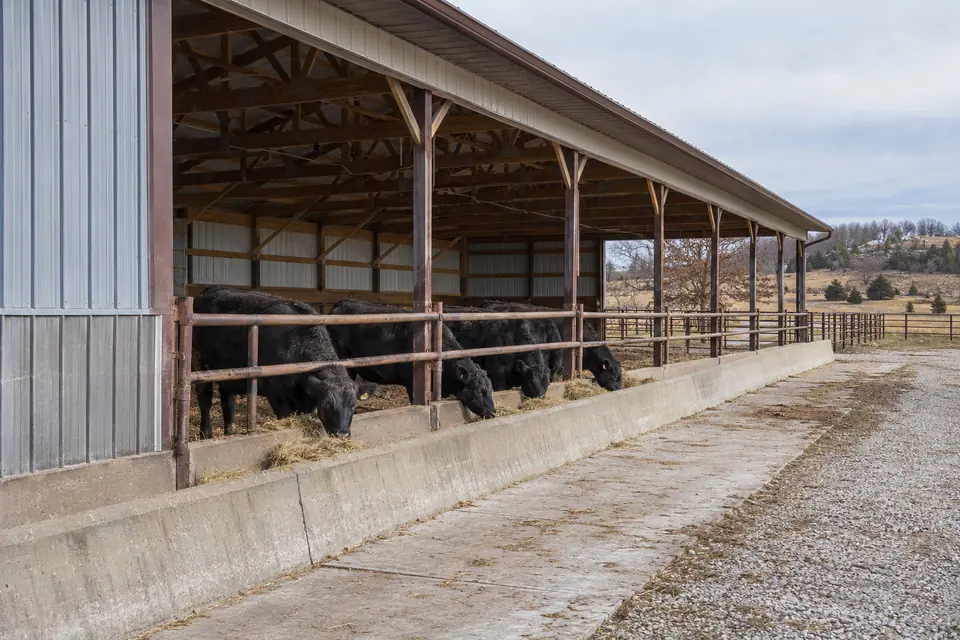
We lay out a cattle barn from the feed line outward. A concrete apron along the bunk keeps the feeding side firm, and we pitch it so wash water and rain run away from the pen. Headlocks or a post-and-rail feed barrier mount to posts we set for them, not to the wall girts.
Inside, our columns sit on poured footings with a treated splashboard at the base, and we add a heavy kickwall where cattle rub and push. We plan an electrical rough-in for frost-free waterers and lights in the calving pens before the floor goes in.
What We Ask Wakarusa Farmers Before We Price
Have these answers ready and our estimate will fit your herd.
- Herd size - Head count now and planned.
- Use - Shelter, calving, feeding or hay.
- Equipment - Tractor and feed truck sizes.
- Farm records - What shows the land is principally agricultural.
The Wakarusa Ag Exemption, Step by Step
Shawnee County exempts farm buildings when the land and the building are principally agricultural. The owner files an Affidavit of Agricultural Exemption with a $50 filing fee, and the packet also asks for an Affidavit of Code Compliance, a stormwater affidavit and a driveway entrance if none exists. Floodplain rules still apply. Our agricultural exemption guide walks through each piece.
"An ag-exempt barn can be built any way you like."
"The exemption changes the paperwork, not the wind, so we engineer every exempt barn the same as a permitted one."
Options Wakarusa Cattle Operations Ask Us For
These are the extras we price most on Wakarusa livestock buildings.
Hay bay under the same roof
A walled bay at one end of a gable barn keeps bales close to the bunk and out of the weather.
Working area and chute
A covered alley with a chute and headgate lets you work cattle out of the wind.
Sliding doors and gates
Heavy sliding doors on the ends and gates hung on their own posts take abuse the girts cannot.
Lean-to on an old barn
A mono-slope lean-to added to an existing barn often gives the shelter you need at lower cost.
Wakarusa Livestock Barn Problems We Plan Around
We see these three on older cattle buildings and design each one out.
| What goes wrong | Why it happens | What we do about it |
|---|---|---|
| Bedding stays wet | Shed faces north or sits low | We face it south on the high side |
| Respiratory trouble in a closed barn | No ridge vent, trapped ammonia | We vent the ridge and open the eaves |
| Wall steel pushed out | Cattle rubbing on bare girts | We add a heavy kickwall inside |
What Moves the Cost of a Wakarusa Cattle Building
We price a Wakarusa livestock building by its length, enclosure and fit-out. An open mono-slope shelter is the leanest; a closed barn with pens, a feed apron and a chute carries more concrete and carpentry. We list each line in a free written estimate so you can phase the work.
Length and depth
Head count sets length, and depth sets truss or rafter size.
Enclosure
Open fronts cost less than closed walls, doors and vents.
Concrete and gates
Aprons, bunks, headlocks and gates add thier own lines.
Siting a Cattle Building on Wakarusa Ground
We walk the farm with you and settle these four things before we draw a Wakarusa barn.
- High side of the lot. We pick ground that drains away from the open front, not toward the house or a pond.
- Orientation. The open side faces south or southeast, and the closed back takes the north and northwest wind.
- Hay upwind. We put hay storage upwind of the pens so dust and odor blow away from the bales.
- Truck lanes. We leave a clear lane for feed trucks, trailers and the tractor with a bale spear.
Wakarusa Cattle Shed and Barn Questions
What changes the cost of a Wakarusa cattle shed?
Length, depth and enclosure change the cost of a Wakarusa cattle shed most. We size length from head count and price the frame, steel and footings first. Concrete aprons, bunks, headlocks, gates and closed walls each add a line. We put all of it in a free written estimate so you can phase the extras.
How quickly can a Wakarusa cattle shed be ready?
A Wakarusa cattle shed often moves faster than a house or shop because the paperwork is lighter under the ag exemption. Our crew raises a typical shed in a few weeks once trusses and steel arrive. We build the pad during the wait and plan around calving and haying where we can.
Do you charge to price a Wakarusa barn?
No, we price Wakarusa barns for free and in writing. We walk the farm with you, pick the site, look at drainage and wind and talk through pens, feed and hay. Then we send a written estimate with every item listed, so you can compare it with any other bid line by line.
Do I need to be on the farm while you build?
No, you do not need to be on the farm every day. We ask you to approve the site and the orientation at the start and to tell us where cattle will be during the work. Our crew keeps gates closed, works on its own and walks the finished building with you before we leave.
Does a Wakarusa cattle barn need a county permit?
A Wakarusa cattle barn can skip the building permit when Shawnee County accepts an Affidavit of Agricultural Exemption. The land and the barn must be principally agricultural, and the affidavit carries a $50 filing fee. Any living quarters or garage in the barn never qualify. We help you prepare the affidavit and check floodplain status first.
Why do you build mono-slope sheds for Wakarusa cattle?
We build mono-slope sheds because one roof plane does three jobs. The tall south front lets winter sun reach the bedding, the low back blocks the north wind, and rain runs off the back away from the pen. Air moves under the high front and out the back, so the shed stays drier than a low gable.
Do farm sheds on open Wakarusa pasture need full wind design?
Yes, open pasture puts a Wakarusa shed in Exposure C, and an open front lets wind push up on the roof from inside. Farm buildings can use Risk Category I loads, but we still size every connection for open ground. Our wind exposure guide explains how we design for it.
Is a fully closed barn better for Wakarusa cattle in winter?
Usually not. Cattle handle cold far better than damp, and a closed barn without airflow traps moisture and ammonia from the bedding. We keep most shelters open on the south side, and when you need a closed calving barn, we open the eaves and vent the ridge so stale air keeps moving out without a draft at cattle level.
Who is the best company for pole barns in Wakarusa, KS?
The best Wakarusa builder sites a cattle shed for sun, wind and drainage, vents it properly and handles the ag exemption paperwork. We do all of that on every livestock building and put the price in writing. Call us at 785-503-3791 and we will walk your farm and look at the herd's needs.
Planning a Cattle Shed Near Wakarusa?
Call us at 785-503-3791 or email quotes@topekapolebarnbuilders.com, and we will walk your farm and send a free written estimate.